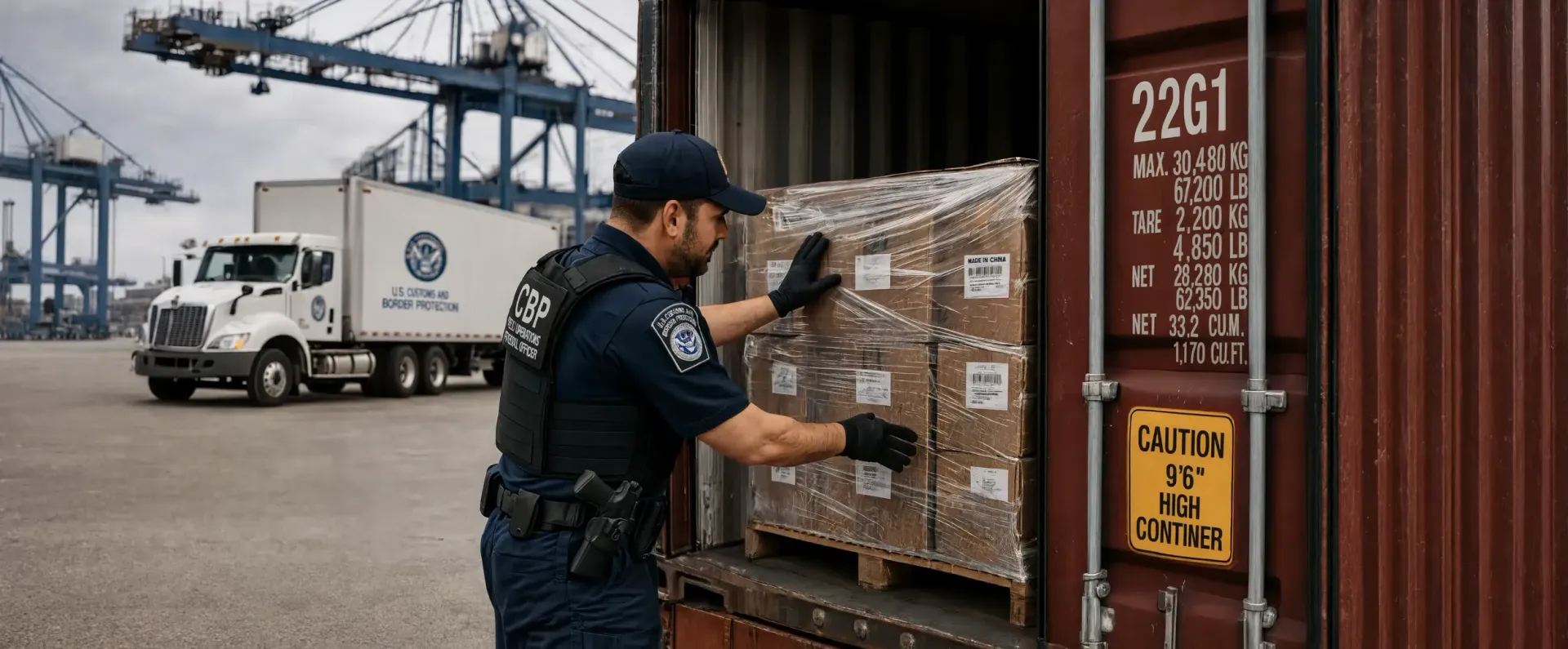
CBP Is Watching: What the June 3 EO Means for Importers

Jill LaMadeleine • June 8, 2026

New EO changes the stakes for importers

On June 3, 2026, President Trump signed the Executive Order (EO) titled Strengthening Customs Enforcement, directing U.S. Customs and Border Protection (CBP) and the Department of Homeland Security to implement sweeping reforms aimed at improving customs compliance, increasing accountability for importers, and combating duty evasion and customs fraud. The order places significant emphasis on ensuring that importers of record are properly vetted, adequately bonded, and fully accountable for the accuracy of information reported to CBP.


While much of the attention surrounding the EO has focused on increased bonding requirements, importer vetting, and tougher penalties, importers should pay particular attention to what the administration has identified as key areas of noncompliance: undervaluation of imported merchandise, inaccurate reporting of import data, and schemes designed to avoid the payment of lawful duties. The EO specifically cites undervaluation and incomplete import information as examples of practices that undermine customs enforcement and federal revenue collection.


For importers, this means that proper tariff classification and customs valuation are more important than ever. Every entry filed with CBP relies on accurate Harmonized Tariff Schedule (HTS) classification and declared value. An incorrect classification can result in underpayment or overpayment of duties, while improper valuation can expose a company to penalties, liquidated damages, and increased scrutiny during audits or investigations. With CBP expected to enhance enforcement efforts and establish a minimum penalty floor for customs violations, the financial consequences of errors may become more significant than in the past.


Many importers have experienced substantial changes in duty exposure over the past several years due to Section 301 duties, Section 232 measures, IEEPA tariffs, and other trade actions. As duty rates increase, so does CBP's interest in ensuring that merchandise is properly classified and accurately valued. Even a seemingly minor classification error can have a substantial impact when applied across large import volumes.


As customs professionals, we frequently find that classification decisions made years ago continue to be used without periodic review, despite changes in product design, sourcing, tariff provisions, or CBP guidance. Similarly, valuation practices may evolve over time as companies restructure supply chains, establish related-party transactions, or implement new purchasing arrangements. These changes can create compliance risks that may not be immediately apparent.


The EO serves as a reminder that import compliance should not be viewed as a one-time exercise but as an ongoing process. Importers may benefit from periodically reviewing their classification methodologies, valuation practices, country-of-origin determinations, and supporting documentation to ensure they remain aligned with current regulations and CBP expectations.

With CBP signaling a more aggressive enforcement posture and a renewed focus on duty collection, importers should take this opportunity to evaluate the accuracy of their customs data before regulators do. A proactive review can help identify potential issues, strengthen compliance procedures, and provide confidence that import operations can withstand increased government scrutiny in the years ahead.


Try Our Refund Calculator
ITM-Refund-Calculator
Questions? Let's talk.

GET STARTED HERE

Down arrow in a black circle.

Get actionable advice on cost-saving strategies that boost your bottom line.

Subscribe here:


DOJ appeals IEEPA refund order | June 2026 update from ITM.
By Jill LaMadeleine June 4, 2026
DOJ appeals IEEPA refund order, putting $166B at risk for non-plaintiff importers. Section 122 struck down but expires July 24. June 2026 update from ITM.
CAPE Platform Live, ACH Payments Required
By Jill LaMadeleine May 7, 2026
CAPE is live — IEEPA refund claims are open. CBP goes ACH-only for all drawback payments. Audits are surging. ITM's May 2026 trade compliance update.
Importers must file claims when CBP's CAPE system launches
By Jill LaMadeleine April 7, 2026
$165B in IEEPA tariff refunds ordered by court. New Section 301 investigation opens. CBP limits AI customs platforms. ITM's April 2026 trade compliance update.
landmark Supreme Court ruling
By Jill LaMadeleine March 3, 2026
IEEPA tariffs ruled illegal by the Supreme Court — CBP has stopped collecting. New Section 122 duties are now in effect. Here's what importers need to know.
Jewelry TV Duty Drawback
By Jill LaMadeleine February 17, 2026
JTV cut duty drawback workload 50% after switching to ITM. See how Jewelry Television recovered a near-complete backlog and transformed their entire process.
PEM America
By Jill LaMadeleine February 4, 2026
Ed Greenberg, Managing Director of PEM America, explains the hundreds of thousands of dollars his company recovered through duty drawback.
The Supreme Court will soon decide whether IEEPA tariffs are legal
By Jill LaMadeleine January 27, 2026
Supreme Court will soon rule on IEEPA tariffs. Learn the 3 steps importers must take now to protect refund rights before liquidation deadlines pass.
Detailed analysis of a duty-free classification for video prints.
By Jill LaMadeleine January 19, 2026
$450K in duty refunds realized through a detailed analysis and evaluation of duty-free classifications made by International Tariff Management.
SCOTUS to Rule on Reciprocal Tariffs
By Jill LaMadeleine January 6, 2026
January 2026 trade update: OBBBA targets tobacco drawback, Section 232 delayed, reciprocal tariffs still eligible for refunds. Plus: why 2026 is enforcement year.
2025-a-year-of-change-and-vigilance
By Jill LaMadeleine December 9, 2025
2025 began with the promise and the introduction of sweeping, high tariffs on nearly all imports. While there was a transition to a two-tiered system including broad tariffs and country-specific rates, the mid-year brought pauses, renegotiations, and recalibrations.
Jewelry Manufacturing
By Jill LaMadeleine November 14, 2025
The benefits that we realized working with International Tariff Management was that they made the process seamless from beginning to end.
Supreme Court of the United States
By Jill LaMadeleine November 4, 2025
Oral arguments are scheduled to begin this week with the Supreme Court in regards to the Reciprocal Tariffs - starting Wednesday November 5, 2025.
International Containers
By Jill LaMadeleine October 13, 2025
The Supreme Court, which resumed on October 6th, has agreed to hear the case in regards to the reciprocal-tariffs (IEEPA), on an expedited basis.
Satellite manufacturer claims reciprocal duties on goods launched into space
By Jill LaMadeleine September 15, 2025
By leveraging the option to claim drawback on items launched into space, the importer was able to recover substantial funds — and cover these unexpected costs which they in turn did not have to pass along to their manufacturing partners.
Reciprocal Tariffs
By Jill LaMadeleine September 9, 2025
The latest on the reciprocal tariffs have them hanging in the balance. On August 29, 2025, the U.S. Court of Appeals for the Federal Circuit, affirmed a lower court decision finding that the reciprocal tariffs exceeded presidential authority under IEEPA. The court stayed its mandate until October 14, 2025, giving the g
Under the Enforce and Protect Act (EAPA), USCBP Officers investigate and halt duty evasion.
By Jill LaMadeleine August 15, 2025
The Department of Justice (DOJ) has officially elevated trade and customs fraud—including tariff evasion—to its #2 enforcement priority. This shift is part of a broader strategy under the Trump administration to enforce high tariffs and ensure accurate revenue collection.