November Newsletter | CBP Updates the 50% Tariff on Canadian Imports
TOP NEWS:
Canadian tariff list changes take effect October 30
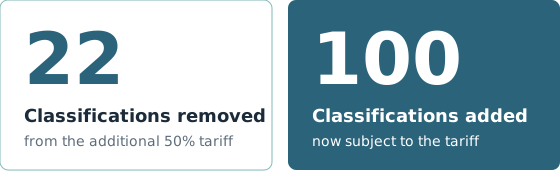
Effective October 30, 2026, U.S. Customs and Border Protection (CBP) is implementing changes to the additional 50% tariffs on certain Canadian imports under Section 338, following a presidential proclamation issued October 23, 2026.
The changes include removing 22 product classifications from the additional 50% tariff and adding 100 new product classifications that will now be subject to the tariff. The existing requirements for other tariff classifications remain unchanged.
Importers should review the updated list of affected HTSUS classifications to determine whether their products are newly subject to the additional duty or qualify for removal from the tariff. Customs brokers should also ensure that entries are filed using the correct tariff classifications for goods entered on or after October 30.
Importantly, the additional duties imposed under HTSUS classifications 9903.03.12, 9903.03.13, and 9903.03.14 are eligible for duty drawback, subject to applicable requirements. Other duties, including antidumping and countervailing duties, may still apply even when a product is exempt from the additional tariff. These changes apply to goods entered for consumption, or withdrawn from warehouse for consumption, on or after October 30, 2026.

SECTION 301 FORCED-LABOR TARIFFS:
Forced-labor tariffs make expert trade guidance essential
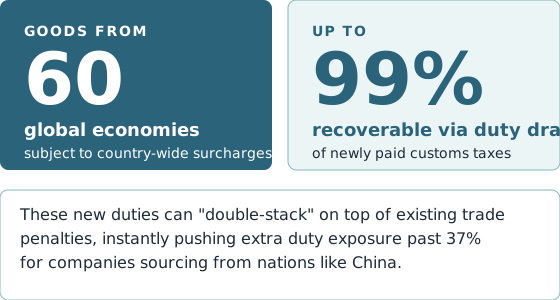
The sudden rollout of the new Section 301 forced-labor tariffs has caught many U.S. importers off guard, adding unexpected country-wide surcharges on goods from 60 global economies. It is vital to understand that these tariffs are not individual product detentions; instead, they are broad macro-level penalties that apply even if your specific items have no connection to forced labor. For companies sourcing from nations like China, these new duties can "double-stack" on top of existing trade penalties, instantly pushing extra duty exposure past 37%. Navigating this complex new landscape requires precision, as existing tariff exclusion codes cannot be used to bypass these new subheadings.
Amidst these heavy financial penalties, a silver lining exists for proactive businesses: these forced-labor duties are fully eligible for duty drawback. This means your company can recover up to 99% of these newly paid customs taxes if the imported merchandise is later exported or destroyed under customs supervision. Additionally, under CBP's HTSUS Chapter 99 Note 52 guidance, several sectors, such as pharmaceuticals, civil aircraft, wood, and specific metals, enjoy blanket exemptions from the tax entirely. Identifying these cost-saving opportunities requires a deep, technical dive into your supply chain data.
Because the rules are complex and the legal environment is shifting rapidly due to active federal lawsuits, attempting to handle these changes internally can lead to costly compliance errors or missed refund opportunities. Partnering with a specialized duty drawback and classification service provider is the most effective way to protect your bottom line.
CAPE PHASE 3 AND PHASE 4 STATUS:
CAPE Phase 3 is limited while Phase 4 is proposed
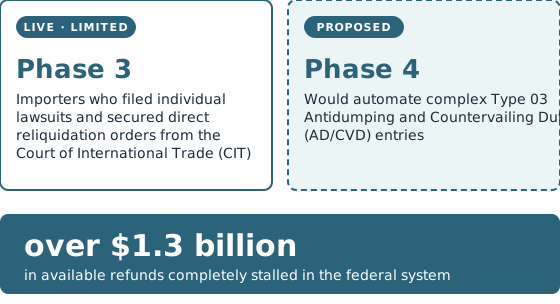
CBP is moving forward with its CAPE platform to issue court-ordered tariff refunds, but navigating the system remains a major hurdle for standard importers. CAPE Phase 3 is currently live but is limited to importers who filed individual lawsuits and secured direct reliquidation orders from the Court of International Trade (CIT). While a nationwide class action was certified to help everyday importers get paid, the Department of Justice is actively appealing it. Because of this legal gridlock, companies without individual lawsuits are locked out of Phase 3, leaving over $1.3 billion in available refunds completely stalled in the federal system.
Meanwhile, trade groups are aggressively pushing for the immediate creation of CAPE Phase 4 to automate complex Type 03 Antidumping and Countervailing Duty (AD/CVD) entries. Currently, Type 03 entries are completely excluded from automated processing due to their volatile liquidation tracks and overlapping Department of Commerce instructions. A motion recently filed at the CIT aims to force CBP to expand the platform. If approved, Phase 4 would standardize interest calculation protocols and provide an automated fast-track to recovery, preventing billions of dollars in AD/CVD-related capital from being trapped for years in manual administrative backlogs.
Because the legal landscape is shifting rapidly between these phases, companies impacted by these specific emergency duties are highly encouraged to monitor the ongoing CIT proceedings closely. Staying informed on these liquidation tracks is vital for any business tracking broader trade-remedy distributions and historical import data.
GET STARTED HERE
Get actionable advice on cost-saving strategies that boost your bottom line.
Subscribe here: